Heat Stress in Llamas and Alpacas
- This article references veterinary medical and/or surgical information. Consult with your veterinarian as appropriate.
- Friday, Aug 15, 2025
Reading time: About 13 minutes.
Llamas and alpacas, native to the cool, high-altitude mountains of South America can be highly susceptible to heat stress in warmer, more humid climates as their thermoregulation mechanisms have become adapted to the milder climates. Their dense fiber, an excellent insulator against cold, can become a significant liability as summer temperatures rise. For animal owners, understanding the science behind heat stress is not just about animal comfort; it’s critical for herd health, productivity, and survival.
In this article, we’ll take a look at deconstructing heat stress, explaining the crucial role of the heat and humidity, outlining practical cooling strategies, and introducing modern monitoring technologies to safeguard your herd.
The Science Behind Heat Stress
Being adapted to cool climates, llamas and alpacas have limited physiological methods for dissipating heat in hot, humid environments. Their primary method of heat dissipation is by air flowing over their thermal windows - the thinner areas of skin and fleece between their front and back legs, and along the underside of their belly 1. Their ability to sweat is limited, so their primary method for acute cooling is through the respiratory system. As body temperature rises, the hypothalamus triggers an increase in the respiration rate, a process known as panting or tachypnea. This rapid, shallow breathing increases airflow over the moist surfaces of the upper respiratory tract, promoting evaporative heat loss to cool the body 2 3 1.
While effective for cooling, panting is what’s known as a non-selective process. The rapid exhalation required to dissipate heat inevitably purges excessive amounts of carbon dioxide (CO2) and water (H2O) from the blood via the lungs. This is the critical juncture where the animal’s acid-base balance is compromised 4.
The acidity of the animal’s blood is controlled by the carbonic acid-bicarbonate buffer system, a key chemical mechanism in homeostasis. In chemical terms, the buffer system is this reaction:
In this buffer system, carbon dioxide and water (left) combine to form carbonic acid (center) which further dissociates into the bicarbonate and hydrogen ions (right) which determine the acidity of the blood. Under normal conditions, these components are balanced to keep the acidity (pH) of the blood between 7.35 and 7.45 4.
When a llama pants excessively, it rapidly lowers the concentration of dissolved carbon dioxide in the blood, which pushes the equation to the left and forces more hydrogen ions and bicarbonate ions to combine and make the blood more alkaline (i.e. raises to a higher pH). When the animal’s blood pH rises above 7.45, the animal enters respiratory alkalosis1.
To compensate for the rise in pH, the kidneys reduce bicarbonate reabsorption back into the bloodstream. To maintain electrochemical balance in the animal’s urine, the kidneys bind a positive ion with the negative bicarbonate ion. As sodium is one of the more commonly found extracellular positive ions in the animal’s body, sodium is typically bound with the bicarbonate in the kidneys, and excreted in the urine 5, leading to dilutional hyponatremia, a condition where the animal is depleted of sodium.
The kidneys also respond to the decreased blood volume through water loss due to evaporation. Signals from pressure sensors in key arteries trigger the release of Anti-Diuretic Hormone (ADH) by the hypothalamus which causes the kidneys to further concentrate the urine, and reabsorb more water 6 7, one symptom of which is scrotal swelling in intact males.
Absorbing additional water while simultaneously excreting more electrolytes will lead to an electrolyte imbalance if not treated promptly. As sodium is required for proper nerve function, the animal may be lethargic, reluctant to stand up, or appear weak. Aggressive rehydration of an animal in this condition with plain water can exacerbate the condition, as the animal requires electrolytes as well as water and plain water by itself will cause the electrolytes in the animal’s extracellular fluid to be further diluted.
As the sodium concentration level falls, the extracellular fluid becomes hypotonic relative to the intracellular fluid in the animal’s brain, and water moves from the extracellular fluid into the intracellular space in the brain through osmosis, leading to cerebral edema, which can cause seizures and convulsions.
Key Takeaways
- Llamas and alpacas are adapted to cool climates, and have evolved limited ways of dealing with high temperatures. Llamas and alpacas will pant when they get excessively hot.
- Through a number of different biological processes, panting alters their blood chemistry.
- These blood chemistry changes can lead to permanent injury unless treated promptly.
Signs of Heat Stress
Early detection is key to stop the condition progressing. As the heat and humidity rises, monitor the herd closely for the following signs:
- Nasal flaring
- Increased respiration rate (normal: 10-30 breaths/min)
- Panting or open-mouthed breathing
- Lethargy or depression
- Reduced appetite
- Seeking shade and spread out for maximum contact with the cool ground.
As the condition progresses, more severe signs are:
- Drooping lower lip and excessive salivation
- Weakness, stumbling, or inability to stand
- Scrotal swelling in intact males
- Elevated rectal temperature - normal range is 99.5–102°F (37.5–38.9°C)
- Difficulty standing or walking
- Convulsions or collapse
Key Takeaways
- Each animal is different, and as a result it is vitally important to know your animals well enough to establish a baseline behaviour.
- Even the most subtle behaviour change can be an indicator of a sick animal, and not all animals would necessarily show all symptoms.
The Heat Stress Index and Heat Index
High ambient humidity severely impairs the effectiveness of evaporative cooling, meaning an animal cannot dissipate heat efficiently. One widely accepted, conservative method for livestock is a simple summation that produces a Heat Stress Index (HSI) value 1:
The calculated value can provide thresholds over which certain actions could be taken:
- HSI under 120: Minimal risk, animals should be comfortable
- HSI between 121 and 160: Stress is possible, particularly in high-risk animals
- HSI between 161 and 180: Heat stress is very likely
- HSI over 181: High risk of severe heat stress and potential mortality.
However, we don’t necessarily find this to be a good metric as it can sometimes produce counter-intuitive results. Using a weather station we have at the farm, we continuously calculate the HSI. The chart below shows a ten day period in mid- to late-June 2025:
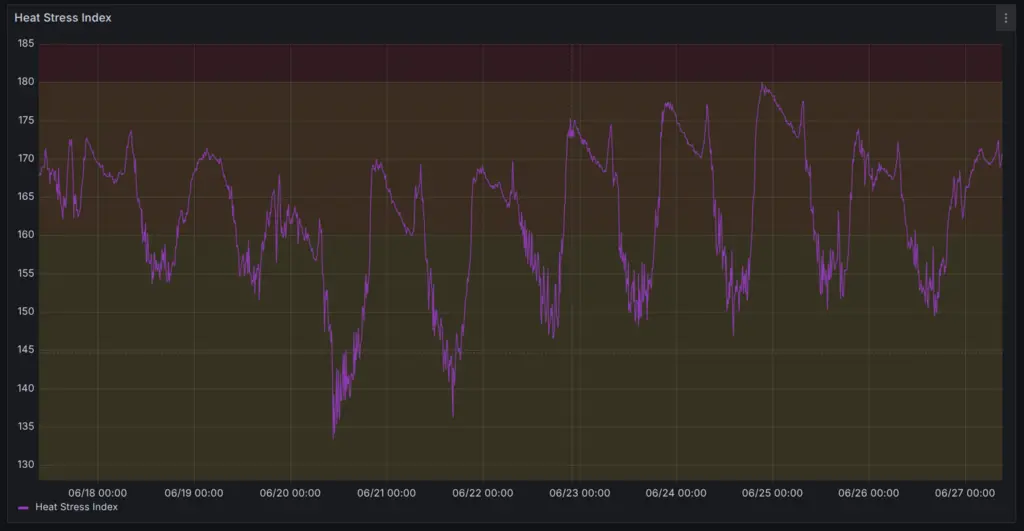
Calculated Heat Stress Index
In this chart, the HSI thresholds indicated above are indicated with wide bands stretching across the chart, coloured in green (below 120, and not visible), yellow (under 160), orange (below 180), and deep red (180 and above) at the very top. Overnight, the humidity quickly reaches 100% with the temperature around 70°F. During the day, the humidity drops to around 55% with temperatures around 95°F. According to the thresholds above, it should be less dangerous for the animals in the heat of the day (with a HSI between 135 and 150) and more dangerous for animals in the middle of the night (with a HSI of 175), which is counter-intuitive.
We use the HSI as a guide, but we primarily use the Heat Index (HI). It’s a more complicated formula, but produces an “apparent” temperature that better represents the conditions outside. The Heat Index Equation we use came from Schoen (2005) 8:
Where
This gives us the following chart for the same ten day period:
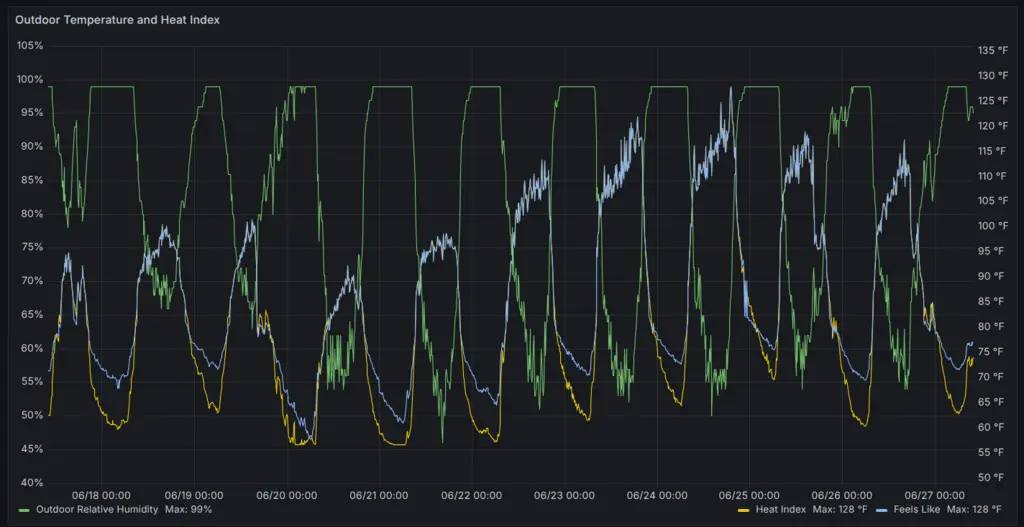
Calculated Heat Index
In this chart, the humidity is the green line, with our calculated “Heat Index” in yellow. The weather station gives us an additional “Feels like” temperature (blue line) which mostly mirrors our calculations, especially at the higher temperatures. We use this Heat Index calculation in combination with this chart from NOAA as part of our risk assessment.
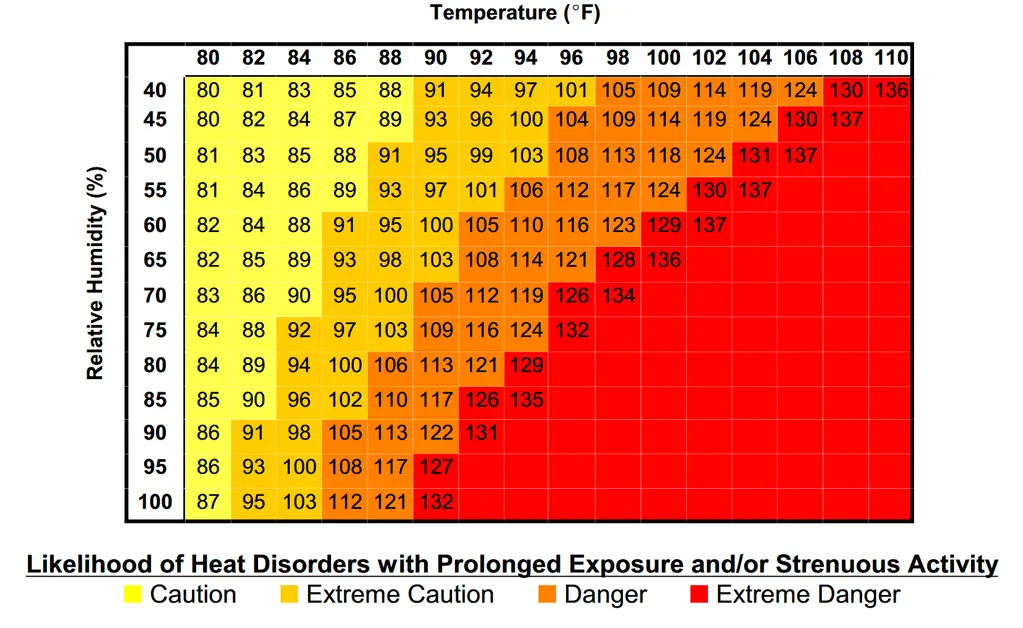
A chart showing the heat index value changing with temperature and relative humidity.
While this chart is designed for humans (who have better evaporative cooling mechanisms than llamas or alpacas), it’s still a very useful tool in risk assessment for the herd, and especially for those people working with them. One important point to note on this chart is that the temperatures noted are shade temperatures, and being in the direct sun can add another 15°F (8°C) to those values 9.
Key Takeaways
- Both high temperature and high humidity contribute to heat stress in llamas, alpacas, as well as humans.
Prevention
Preventing heat stress is far more effective than treatment, and there are a number of simple steps you can take before the heat reaches dangerous levels:
Shearing
Shear your animals before the hot weather starts, being sure to leave enough fiber on the animal to protect pale skin from sunburn. Most of our animals get what we term a “working cut”, which leaves the neck wool long, but takes more hair off the chest and shoulders and allows for more airflow over their thermal windows.
Shade
Adequate, well-ventilated shade (such as trees) should be provided; Barns should have high ceilings, and well-ventilated sides to help with airflow and prevent heat build up. Shade structures should be oriented north-south, and have light-coloured or reflective roofing.
Water
Offer multiple sources of fresh, cool drinking water in shaded locations, and consider adding electrolytes to some (but not all, as some animals may not like the taste). With animals sharing larger water buckets (such as the 15 gallon water buckets), some animals will like to step into the bucket to cool off, so consider paddling pools, splash pads or sprinklers as an alternative to keep their drinking water clean. You could also elevate large buckets or troughs so the animals cannot step into them. Hose down the thermal windows of animals, but not their backs as wet fleece traps heat.
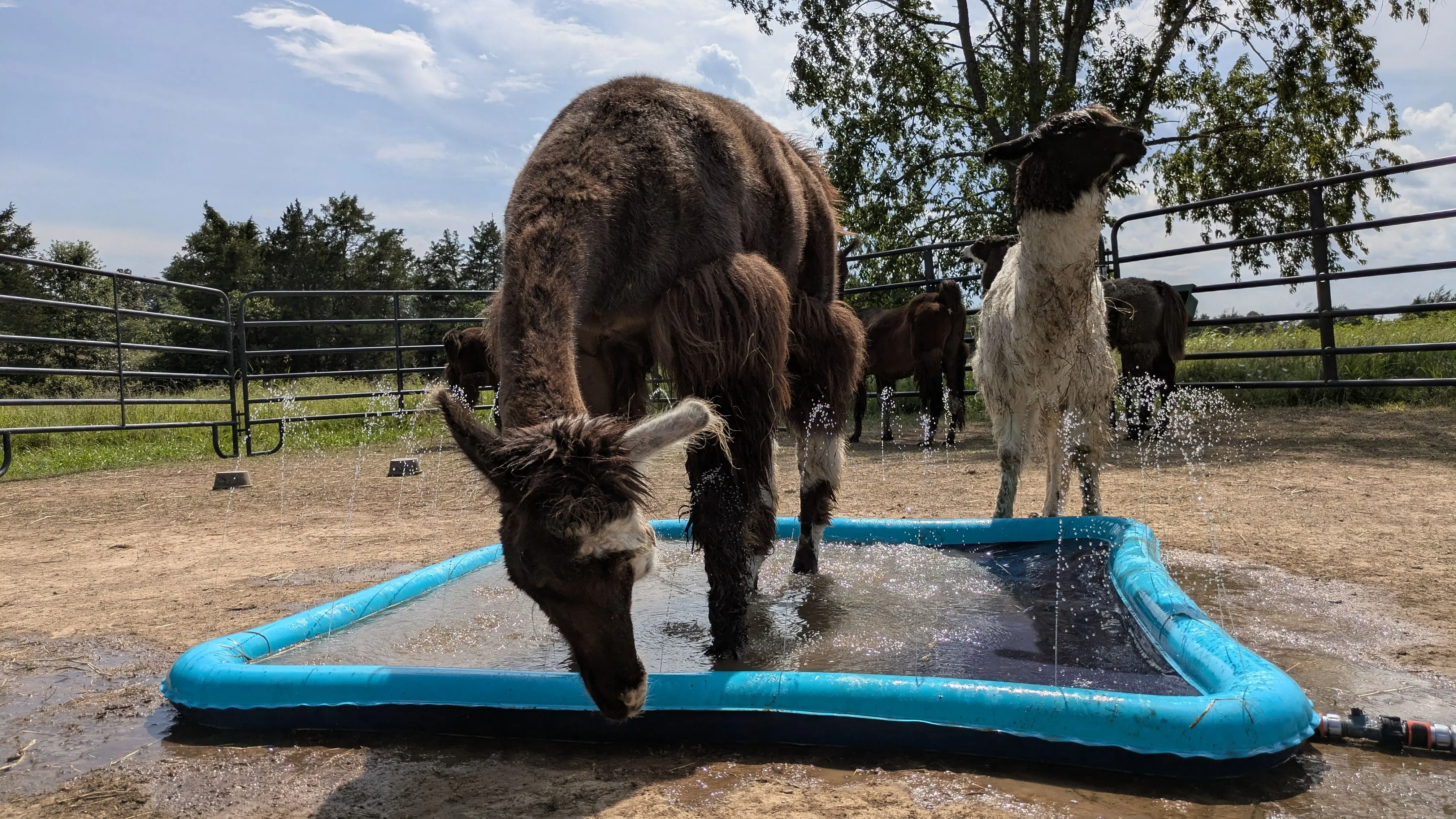
Kabooki and Ladybug check out their splashpad. Note that the water pressure has been adjusted so the water jets do not go up onto their backs. This 96 inch splashpad will fit two adult llamas.
Consider adding electrolytes to some water buckets but not all, as some animals may not like the taste. Some commercial electrolyte mixtures contain probiotics as well as minerals, and the mixture should be discarded daily to prevent bacteria build up, and the bucket scrubbed.
Ventilation
Use large fans to create air movement, and pull air from cooler, shaded areas and direct it down towards the floor where the animals are typically lying down.
Nutrition
The digestion of certain feeds can cause a spike in body temperature, so consider adjusting feed amounts or times to take into account the lower temperatures in the early morning or late evening. Provide free-choice minerals for the animals to eat as an additional source of electrolytes.
Limit Stress
Avoid handling and transporting animals during the hottest part of the day. If animals must be transported, consider bringing additional fresh water, and invest in insulated trailers.
Forecast
Monitor the weather forecast, and be prepared for heat waves lasting several days. While many farms have thermometers to show ambient temperature, an electronic weather station can provide a lot more information, and will give you an at-a-glance view of the current environmental conditions at your location. Many weather apps will provide short- and medium-term forecasts.
Treatment
Animals suffering from heat stress should be treated promptly as it can quickly become life-threatening.
- Cool: Move the animal to a cooler area immediately, out of the sun and if possible onto a cold floor (such as damp sand or concrete), or possibly into a basement or an air conditioned space. Apply water, alcohol, or ice packs (wrapped, to prevent burning and shock) to thermal windows, but avoid wetting the fleece.
- Hydrate: Ensure that the animal has access to cool water.
- Nutrition: Ensure that the animal has free choice mineral to replace lost nutrients, and has access to high quality hay.
- Monitor: Monitor the animal’s temperature.
Your veterinarian will have suggestions for additional supportive therapies, such as IV fluids, vitamin E, flunixin meglumine (Banamine), and selenium 1.
At the Farm
At Lower Sherwood, we take a number of steps to help our animals manage the high temperatures and humidities better:
- Shearing: In Virginia, we’ve started seeing high temperatures and high humidities in mid-June, so we aim to have all of our animals sheared by the end of May.
- Stock up: We keep a supply of appropriate electrolytes, minerals, and medications on hand and use smartphone apps to keep track of stock levels and batch expiration dates. Supplies that we need on a regular basis are shipped automatically.
- Check Equipment: Fans are checked in May to make sure they work, and electrical extension cords and outlets checked for safety.
- Check the Forecast: We have access to the ten day weather forecast through smartphone apps, so we can be better prepared for high temperature and humidities.
- Reduce Activities: We cut back on our off-site activities and on-site training and handling by the middle of June. All off-site activities stop by the end of the 4th July weekend, and resume again in late August.
- Monitor Local Conditions: Our on-site weather station alerts us when the temperature and humidity start climbing.
- Keep Water Buckets Clean: On hot days, we make sure water buckets are scrubbed and cleaned every morning. This both helps to keep algal growth down, and also ensures that the animals have cool, fresh water daily.
- Check Animals More Frequently: Throughout the hot days, we double the number of checks we do on the animals throughout the day, and top off their water buckets as needed.
- Active Cooling: Animals are hosed down as needed. We also provide splash pads for animals to walk in and cool off.
- Portable Shade: We put out temporary, portable pop-up tents to provide additional shaded areas. Combined with a splash pad, they can provide a cool oasis in the heat of the summer.
- Adjust Feeding: Feeding schedules are adjusted to prevent body temperature spikes.
We’ve also taken some additional high-tech steps to make sure our animals are comfortable. Monitoring an animals temperature is the best indicator of how well they are managing their heat levels, however taking the temperature of an animal can be invasive, and stressful for both animals and handlers. Starting in 2025, we’ve started fitting animals with Merck’s Bio-Therma microchips, which will allow us to monitor animal temperatures without thermometers. In order to ensure that these chips give accurate readings, we’re using them in a small number of animals to start with and comparing the temperature from the chip with the animals body temperature to ensure the chips give accurate measurements. Nutmeg is the first animal fitted with one.
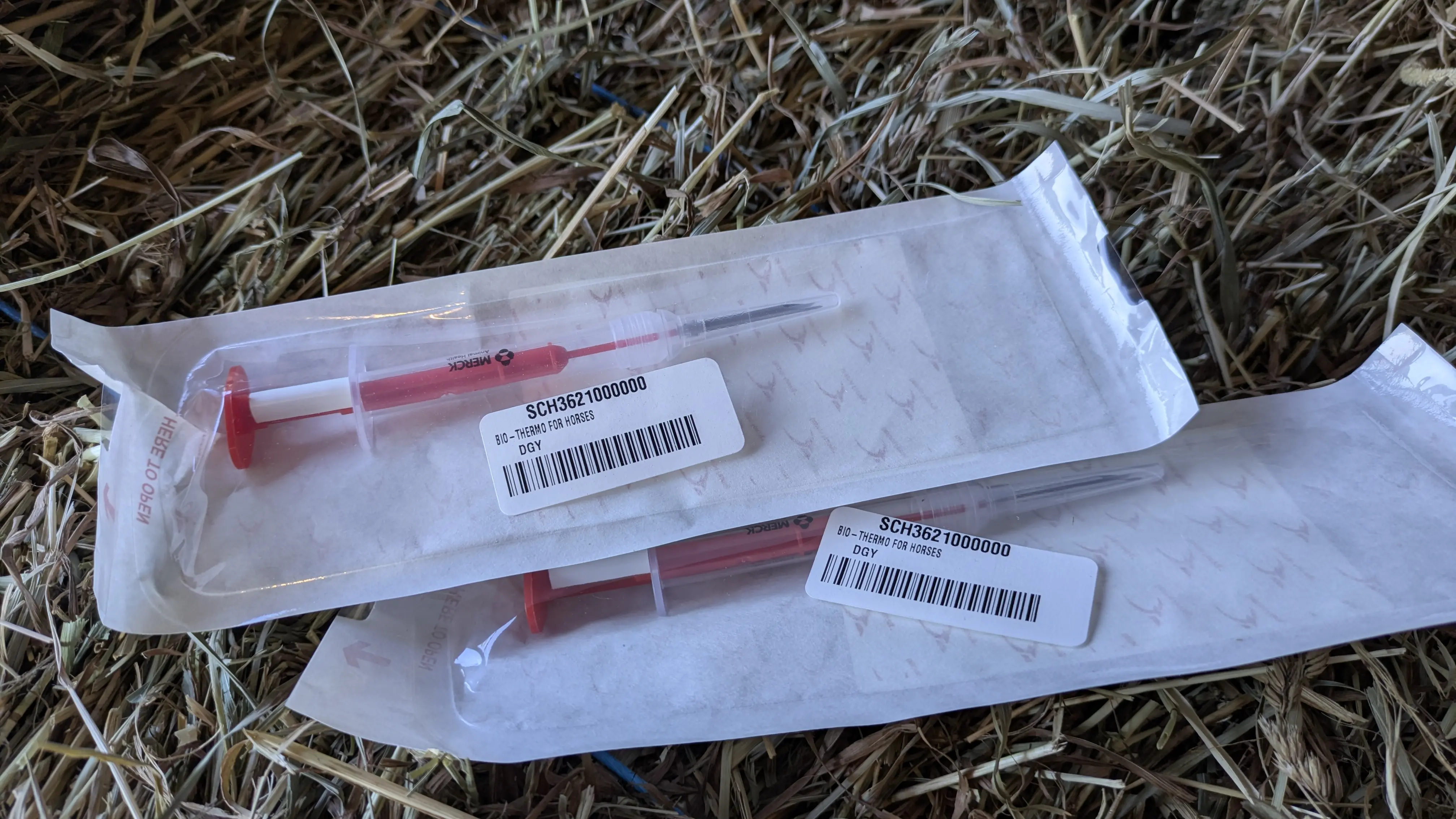
A pair of Bio-Therma Microchips in their red plastic injectors and sterile packaging on top of a bale of hay.
If the temperature reported by the Bio-Therma chip is accurate, we’ll be using them going forward for both permanent animal identification and body temperature reading.
Conclusion
Managing heat stress in llamas and alpacas is an essential component of summer husbandry. By shifting focus from simple air temperature to also watching humidity, recognizing the progressive signs of distress, and implementing robust cooling strategies, animal owners can protect their herd and ensure their well-being through the most demanding months of the year.
References
Norton, P. L., Gold, J. R., Russell, K. E., Schulz, K. L., & Porter, B. F. (2014). Camelid heat stress: 15 cases (2003-2011). The Canadian veterinary journal/La revue veterinaire canadienne, 55(10), 992–996. ↩︎ ↩︎ ↩︎ ↩︎ ↩︎
Osilla EV, Marsidi JL, Shumway KR, et al. Physiology, Temperature Regulation. Available from: https://www.ncbi.nlm.nih.gov/books/NBK507838/ ↩︎
Robertshaw, D. (2006) Mechanisms for the control of respiratory evaporative heat loss in panting animals, Journal of Applied Physiology volume 101, number 2, pp 664-668. Available from: doi:10.1152/japplphysiol.01380.2005 ↩︎
Hopkins E, Sanvictores T, Sharma S. Physiology, Acid Base Balance. Available from: https://www.ncbi.nlm.nih.gov/books/NBK507807/ ↩︎ ↩︎
Sur M, Hashmi MF. Alkalosis. Available from: https://www.ncbi.nlm.nih.gov/books/NBK545269/ ↩︎
Bichet, D. G. (2024). Physiology, Vasopressin. Available from https://www.ncbi.nlm.nih.gov/books/NBK526069/ ↩︎
Kumar, S. (2023). Unraveling the Role of Antidiuretic Hormone (ADH): From Water Balance to Neurological Signaling. Retrieved from https://www.oajournals.org/articles/unraveling-the-role-of-antidiuretic-hormone-adh-from-water-balance-to-neurological-signaling-3024.html ↩︎
Schoen, C. (2005). A New Empirical Model of the Temperature–Humidity Index. Journal of Applied Meteorology, 44(9), 1413-1420. https://doi.org/10.1175/JAM2285.1 ↩︎
National Oceanic and Atmospheric Administration (NOAA). (2023). Heat Index. Available from https://www.noaa.gov/jetstream/synoptic/heat-index ↩︎